Moving from Content API to Merchant API Before the August 2026 Deadline
Google Is Retiring the Content API for Shopping Google has announced that the Content API for Shopping will be permanently...
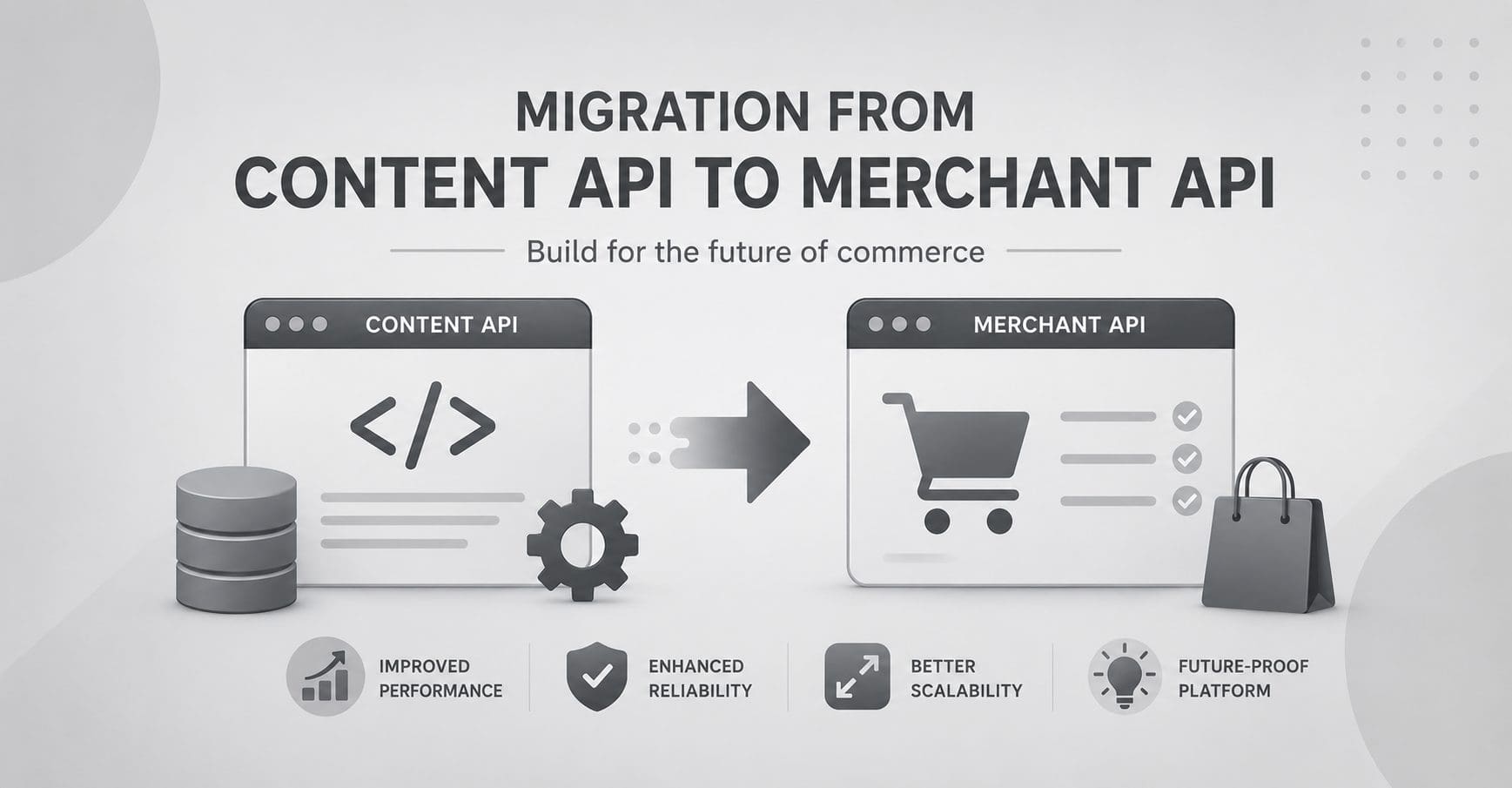
Google has announced that the Content API for Shopping will be permanently shut down on 18 August 2026. Any retailer, ecommerce platform, feed management tool, or custom integration currently relying on the Content API must migrate to the new Merchant API before this date to avoid disruptions to product listings, inventory updates, and Google Shopping campaigns.
If your products are submitted to Google Merchant Center via an API connection, now is the time to start planning your migration.
The Content API for Shopping has been Google’s primary method for programmatically managing Merchant Center accounts for many years.
It allows businesses and developers to:
The API has been widely used by ecommerce platforms, feed management tools, ERP systems, and custom-built integrations.
The Merchant API is Google’s next-generation replacement for the Content API.
Rather than using a single, monolithic API structure, Merchant API introduces a more modular architecture with dedicated APIs for:
This approach provides improved scalability, better performance, and easier future expansion. Google describes the Merchant API as a simplified and more robust way to manage Merchant Center accounts and product data across Google Shopping, Free Listings, and Google Ads.
Benefits of Merchant API include:
You need to migrate if you are:
If your website or platform directly communicates with Google Merchant Center using the Content API, migration is mandatory.
Businesses using third-party feed tools should check with their provider to confirm their migration plans.
Any agency or developer maintaining custom Merchant Center integrations must update their applications before the shutdown date.
Retailers synchronising inventory, pricing, and product information across multiple channels through the Content API will need to migrate.
In Google Merchant Center:
If the source shows Content API, your integration requires migration.
Some ecommerce platforms handle API integrations automatically.
For example, merchants using platform-managed integrations may find their provider completes the migration on their behalf. However, it is still advisable to verify this directly with your platform or extension provider.
All Content API users must complete migration by:
18 August 2026
After this date, Content API requests will no longer function.
Identify:
Document every API endpoint currently in use.
Google has published migration guidance showing how Content API resources map to Merchant API resources.
Pay particular attention to:
Merchant API uses a different URL structure.
Old Content API endpoints:
shoppingcontent.googleapis.com/content/v2.1/
New Merchant API endpoints:
merchantapi.googleapis.com/
Google recommends migrating services individually where possible.
One of the biggest changes is that Merchant API uses resource names instead of many of the numeric identifiers used within Content API.
Developers should review all code that references:
to ensure compatibility.
Merchant API introduces changes to price formatting.
Many price fields now use:
instead of the previous pricing structure.
This often requires updates to custom integrations and data processing logic.
Google recommends running Merchant API alongside your existing Content API implementation during testing.
This allows:
before fully switching production traffic.
Do not leave migration until the final weeks.
Large ecommerce sites often require:
Starting early significantly reduces risk.
Failure to migrate before 18 August 2026 could result in:
For many retailers, this could directly impact sales and advertising performance.
Google has published comprehensive migration resources:
Content API to Merchant API Migration Guide
Content API Release Notes and Deprecation Information
The migration from Content API to Merchant API is not optional. Google has confirmed that the Content API for Shopping will cease operating on 18 August 2026, making migration essential for any business relying on API-based product management.
While the new Merchant API introduces some technical changes, it also delivers a more scalable and future-proof platform for managing products across Google Shopping, Free Listings, and Google Ads.
Businesses using custom integrations should begin auditing and testing now to ensure a smooth transition long before the deadline.
Let’s talk about how Yoma can support your business.
Share this article


Google Is Retiring the Content API for Shopping Google has announced that the Content API for Shopping will be permanently...

It has been two weeks since we returned from Epicor Insights 2026 at the Gaylord Opryland Resort in Nashville. Having...
From there, the working relationship grew as ecommerce became more integral to the operations to Epicors customer base. Our largest...

Epicor Commerce is the ecommerce and customer portal solution for Epicor ERP. Giving your customers the ability to self serve...

In the world of ERP software, names matter. They set expectations. They tell you what a tool is supposed to...
In today’s fast-moving eCommerce world, businesses can’t afford to be limited by technology. Many companies have built their online stores...


Our full-service digital agency can help you realise your vision. No matter what your industry, we see your potential and can build eCommerce solutions that will grow and scale with you.